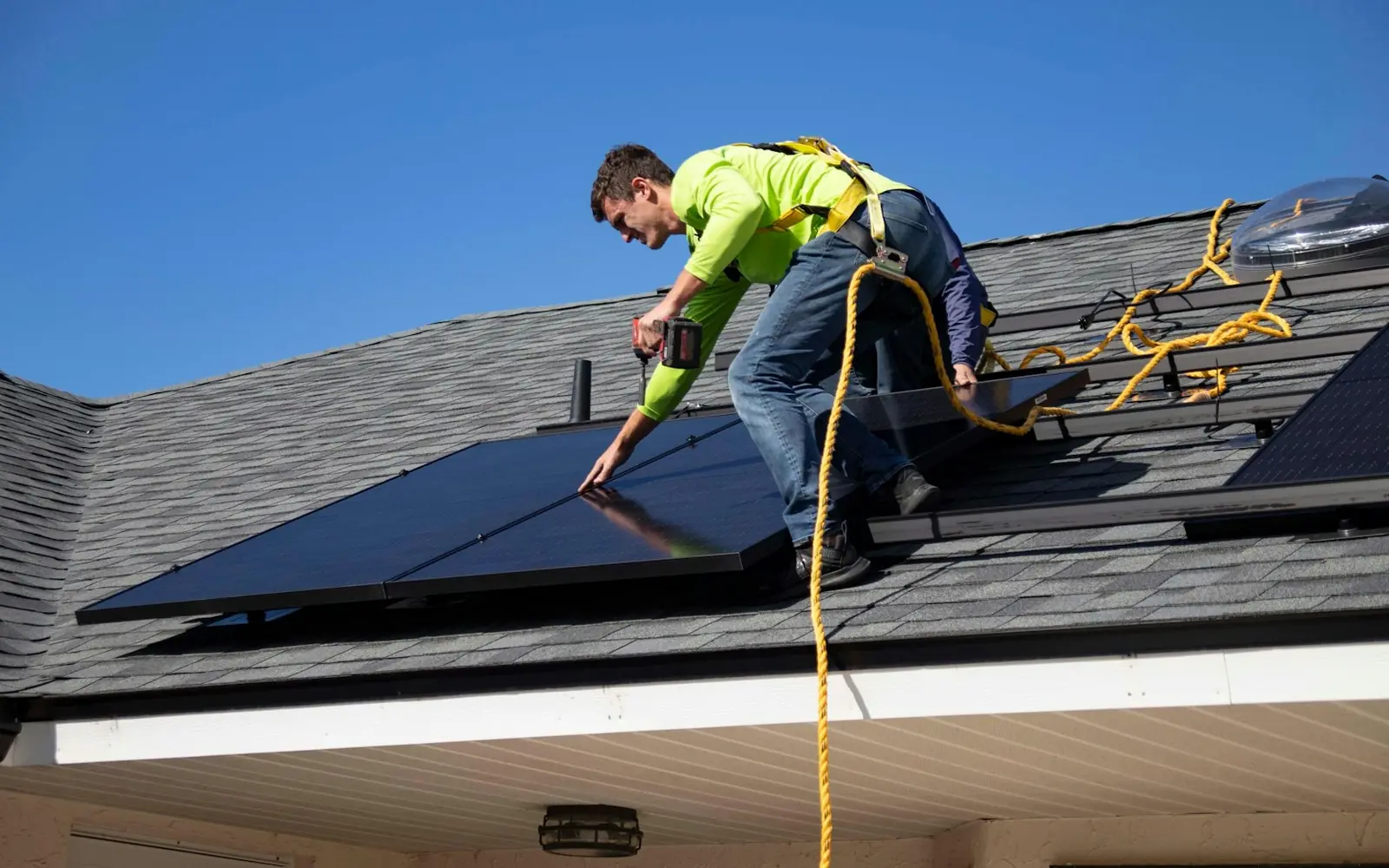
By mid-morning on a July job, the crew has laid rails across a south-facing roof, clipped into anchors and started lifting panels up the ladder one at a time. Solar installers mount and wire the panels that turn sunlight into power for homes, businesses and larger fields. This explains how people start, what training helps and which parts of the work need a license.
The usual way in: Helper work and on-the-job training
A day on an installation
Residential crews spend much of the day on roofs, measuring, drilling, sealing roof penetrations, setting racking and mounting panels. Larger ground-mounted sites look more like construction work, with rows of posts, trenching for cable and long days in the sun. The work is physical, and heat, ladders and fall hazards are part of nearly every job.
Installers also run conduit, connect panels to inverters and help with inspections. Hours often follow daylight and weather, so a crew may start early in summer and lose days to rain or snow.
How helpers get started
Many installers start as helpers or laborers with no solar background, learning on the job from a lead installer. Employers often look for comfort with heights, basic tool skills, a valid driver’s license and the ability to lift panels safely. Some community colleges and workforce programs offer short solar courses that cover safety, system parts and basic electrical ideas.
A national solar certification exists for installers and other workers, with an entry-level credential and a more advanced one that asks for field experience. It is voluntary in most places, though some employers and state programs prefer it. Many crews also complete an OSHA 10-hour construction safety course, which some employers arrange for new hires.
Where a license fits
The electrical parts of a solar system fall under each state’s electrical licensing rules. In many states, a licensed electrician or a worker supervised by one must make the electrical connections, while helpers mount racking and panels. Some states also have a solar contractor license, and a few license individual solar installers.
An electrical apprenticeship is one way to move from mounting panels to wiring whole systems. Your state’s electrical licensing board can say which tasks need a license and how apprentice hours are counted.
The electrical parts of a solar system fall under each state’s electrical licensing rules.
What you can do this week
- Ask an installer whether it hires helpers without experience
- Look up an OSHA 10-hour construction course near you
- Read your state’s electrical license rules for solar work
- Ask a community college about short solar courses
Worth remembering. Many solar installers begin as helpers, and the wiring side of the work often depends on a state electrical license.